
The Meaning of Mentor
What is the meaning of mentor? And who can be a mentor?
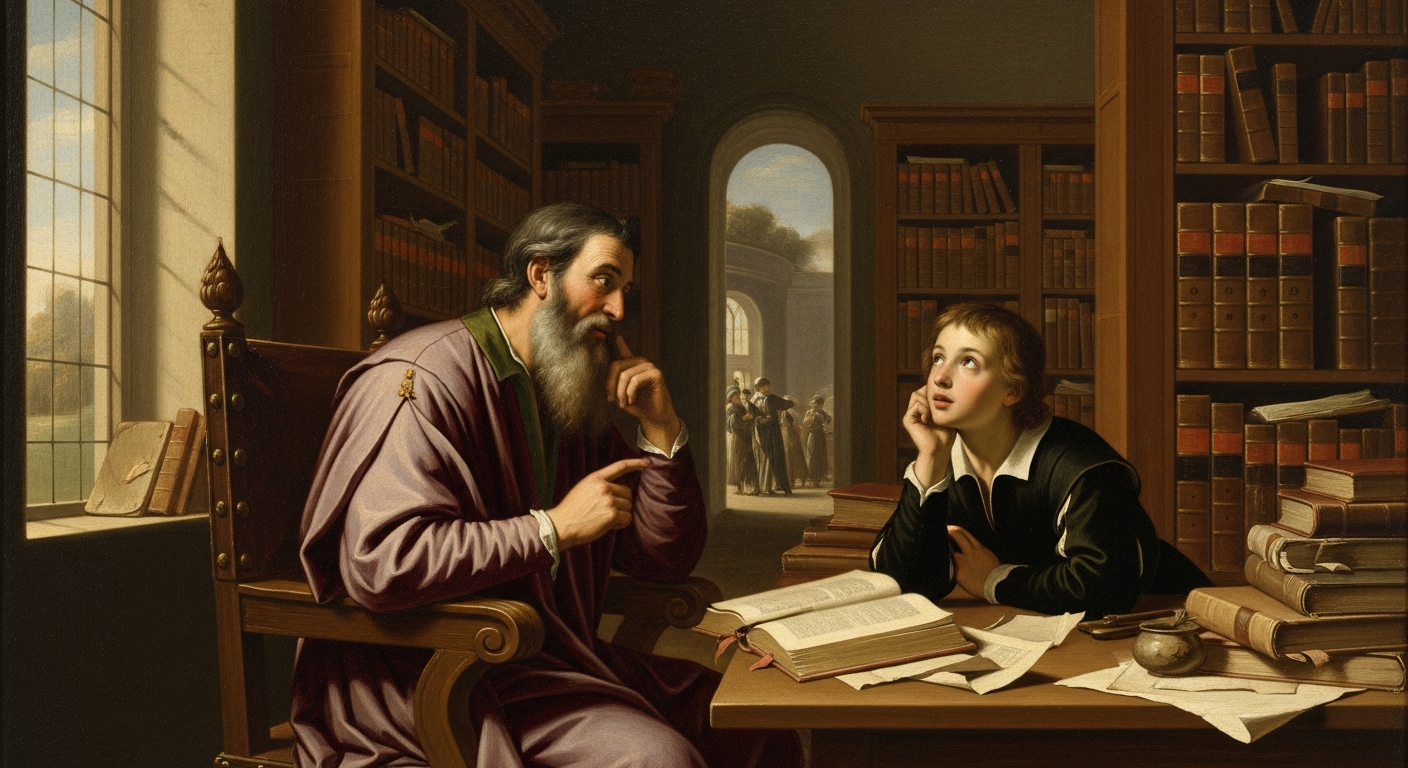
AI-generated image
A little later in the story, the goddess Athena takes the form and voice of Mentōr to advise Telemachus to search for his father.
In the 1700s, the word Mentor became the common noun mentor, meaning ‘wise counselor.’ Prior to this change, the word was bound within a story. Mentōr, in the epic poem the Odyssey, is the friend of Odysseus, the guide of Telemachus and a portal for the goddess Athena.
In one sense, it may seem of little importance that Mentōr faded away and mentor gained its place. It may seem good that the word changed form and took on a common ability to describe those we deem ‘wise counselors’ in our lives. However, stripped from person, from story, the word became independent and, loosed from its original ties, was in danger of being forgotten, the old meaning gutted out over time and re-filled with another. The word, no longer couched within and inseparable from the story of Odysseus, could now be remembered outside of that story, outside of Mentōr, outside of his friends, the kingdom, the gods. Which, perhaps, is the very thing that has happened.
We say a mentor is a ‘wise counselor.’ The majority of people would easily agree on this. But, when you begin to ask what it means to be wise, and who is a counselor, and in what way and about what people should be counseled, suddenly a thousand answers emerge. The word is used in an appearance of agreement, and yet people can mean very different things. They see the world in very different ways. The word, today, is free-for-all. It lost its tie, and in time lost its old meaning, and today fluctuates in meaning from person to person.
On the whole, it is reduced to some vague notion of a supportive relationship and good advice, other words that have no grounded sense of meaning in and of themselves. Perhaps relationships and good advice really mean feeling good or feeling secure or able to live your best life — and those meanings are rooted in something very foreign to any Christian understanding of life or this world.
What do we mean by ‘mentor,’ and who is a Mentōr?
Mentōr, in the Odyssey, is the friend of Odysseus.
“With these words he [Telemachus] sat down, and Mentor, who had been a friend of Ulysses (Odysseus), and had been left in charge of everything with full authority over the servants, rose to speak. He, then, plainly and in all honesty addressed them [the councellors].” (Book II)
Their friendship is repeatedly mentioned throughout the story.
Mentōr stands up to speak to the counselors who, while Odysseus is on the voyage, are spending their days in gluttony and pleasure, in disloyalty to Odysseus. Mentōr, aside from Telemachus, Odysseus’ son, appears to be the only one that speaks to the counselors of their wrongdoing.
A little later in the story, the goddess Athena takes the form and voice of Mentōr to advise Telemachus to search for his father. Then, many times throughout his voyage and the rest of the story, Athena appears in the form and “with the voice” of Mentōr to guide Telemachus. At times, Telemachus believes it may be the goddess speaking to him, and at other times does not perceive she is the one speaking to him.
Mentōr speaks “plainly and in all honesty.” He speaks despite being the only one to speak and despite the actions and opinions of others being the opposite of his. He speaks as a friend, in honor of a friend, sacrificing his own approbation and pleasure for his friend who he cannot even be sure is still alive. He is not speaking in all honesty to be “right,” but simply because there is something he knows to be true, and because he loves Odysseus, and this loyalty is for the well-being of Odysseus, the counselors and the kingdom.
Mentōr is a wise friend. His wisdom is not ‘heady knowledge,’ though he has the knowledge and experience to have been entrusted the entire kingdom. He is able to guide the kingdom in the King’s absence, but his knowledge is undergirded with the deepest wisdom. He is willing, when on the line, to remain loyal. He is such a person that divine wisdom passes through him to others.
In a few words, we could say he is a real person – a whole person, a person close to the gods, honest, wise, full of sand. Full of love.
Of course, with the coming of Christ, and the dawn of Christianity, the gods and divinity and our understanding of who God is became fully revealed. The Odyssey was a shadow of what was to come, and yet remains a story that still gives a strong sense of what is true.
What we are in need of today more than ever before are Mentōrs. The manuals on library shelves on ‘how to raise children’, ‘schooling methodologies’, ‘how to grow a garden,’ and ‘how to understand emotion’ all testify to an absence of guidance and a thirst for it. The proliferation of therapists and counselors reveal this need as well. As humans, we need a Mentōr. However, knowledge of person and deep love, reliable and strong, has been replaced by the implementation of scientific methodologies that promise stability.
And yet, if we understand ourselves as beings that must be known in ways that come from simply living and being with one another, do our therapists and counselors actually know us to the point where they can truly see us better than we see ourselves? Do they have the deep love and commitment of a friend? Perhaps some do. But, for many, how could they without living life alongside each person and without having fully lived an experienced, committed life themselves?
We are all in need of Mentōrs who are not some category of professionals or people who have certain qualifications and fit into a certain box, but are simply real people. People who have lived in our world fully, and have a wisdom not of this world. People in whom heaven and earth are united, and who can guide those of us that are trying to become real too. To suppose manuals or a methodology can help us, and replace them, assumes a scientific, mechanical, systematic understanding of the world. It assumes that we, also, are machine-like.
Suppose, though, we believe we are unique persons in a very alive and dynamic world. A world in which no one life will or can be the same, though we have a common home and hope in Paradise. A world in which sacrifice heals and brokenness is due to a lack of love. In such a world, no methodology could truly heal.
Mentōrs are parents. Mentōrs are grandparents. Aunts and uncles. Our mother’s friend. Our neighbor.
We have lost something precious. Not just something nice, but something that we need just as much as we need the air to breathe. Most everyone, especially the young people in our time, feel this extremely deeply. And we have lost something that, if we truly had love, should not have ever been disposed of. We have lost something that cannot be recovered by a system or method; it was lost by a system and method. The recovery would lie in something as different from a system as the friend and guide Mentōr is from a manual.
Nina Tarpley is a writer and educator working with Christian Halls International. Her writing centers on the personal and pedagogical dimensions of CHI's project — the meaning of mentorship, the formative life of a place, and what it means to educate human beings whose loyalties, hopes, and loves are still being formed.